
Introduction
At the outset of 2026, with the launch of the military operation in the Sheikh Maqsoud and Ashrafieh neighborhoods of Aleppo1, areas east and west of the Euphrates River in Syria experienced a rapid escalation across military, political, and social levels. This escalation paved the way for large-scale military operations conducted between 10 and 18 January 2026. These developments did not emerge in isolation; rather, they were preceded by significant shifts during the final months of 2025.This context included a steady decline in the influence of the Syrian Democratic Forces (SDF) across areas under their control, particularly following their withdrawal from the city of Aleppo, which contributed to altering the balance of territorial control on the ground. Tensions further intensified as the SDF carried out multiple attacks on the city of Aleppo using loitering munitions, prompting the Syrian army to expand its military operations east of Aleppo, advancing from Deir Hafer and Maskanah toward al-Hasakah over the course of several days. Ultimately, these developments contributed to exposing the erosion of the local legitimacy of the de facto authority, the Autonomous Administration, in the eyes of residents, particularly in Arab-majority areas.
areas east and west of the Euphrates River in Syria experienced a rapid escalation across military, political, and social levels.
This paper examines the developments of the military operation east of the Euphrates during the period 10–18 January 2026 through three interrelated levels: the military-security level (axes of advance, task allocation, and operational role integration); the social level (the role of tribes and local actors in shaping control dynamics); and the media level (official and parallel narratives and their impact on legitimacy and public trust).
Military Unit Movements East of the Euphrates
The military units that participated in the operation to secure Sheikh Maqsoud on 10 January 2026 subsequently redeployed to reinforce frontline positions with the Syrian Democratic Forces (SDF). Units associated with Divisions 60 and 72 moved to contact lines west of the Euphrates River to strengthen the Syrian army’s defensive posture2. Additional forces were dispatched to Deir Hafer, east of Aleppo, to secure the city after it had been targeted multiple times by SDF drone attacks.
Following the designation of the area as a military zone, and within hours of this announcement, the SDF declared its withdrawal from the areas of Deir Hafer and Maskanah west of the Euphrates. In response to continued violations attributed to the SDF, the Syrian army’s Military Operations Authority declared the city of al-Tabqa and its surroundings a restricted military zone. Syrian military units subsequently gained control of al-Tabqa and all territories west of the Euphrates, coinciding with the collapse of SDF defensive lines.3.
Six principal divisions of the Syrian army participated in the military campaign against the SDF. Their operational theaters extended across both western and eastern banks of the Euphrates, involving Divisions 60, 66, 72, 86, 52, and 44. Each division was assigned specific geographic axes, while several joint axes were managed collaboratively in certain sectors. Each formation was tasked with clearly defined field responsibilities, reflecting a high degree of operational integration that was evident in the rapid pace of territorial advances.
Six principal divisions of the Syrian army participated in the military campaign against the SDF.
Following the SDF withdrawal, military forces advanced along the Deir Hafer axis through a phased entry, with one division assuming the role of the spearhead in urban assault and close-quarters combat. These formations continued their advance into the western countryside of Raqqa governorate, while other units operating along support and stabilization axes provided fire support, secured frontline positions, and conducted follow-on clearance operations after initial assaults.
In parallel, other military formations launched offensive operations against SDF positions, advancing from the western countryside of Raqqa toward the city of al-Tabqa, before continuing gradually toward Raqqa city itself. Concurrently, additional formations advanced from eastern Raqqa countryside toward the city. Subsequently, forces advancing from the northern Raqqa axis moved toward Ain Issa, a strategic junction influencing supply routes and communications toward Raqqa.
Analysis of these operational axes indicates a deliberate attempt to isolate Raqqa from Ain al-Arab/Kobani in the Aleppo countryside, given its role as a key logistical and manpower reinforcement hub for the SDF. This maneuver effectively narrowed the SDF’s operational options to either withdrawing toward al-Hasakah or retreating northward toward Ain al-Arab/Kobani.4.
Along the Euphrates corridor and the Iraqi border, from al-Bukamal to al-Ya’rubiyah, and amid the collapse of SDF defensive lines in Raqqa, a tribal uprising emerged in the eastern countryside of Deir ez-Zor against SDF forces. The unrest subsequently spread to surrounding rural areas, creating operational gaps that were exploited by special forces units along the Euphrates axis. These units conducted infiltration and river-crossing maneuvers from the opposite bank of the Euphrates into the depth of SDF-controlled territories in the eastern countryside, supported by an accompanying artillery unit operating along the same axis.
Subsequently, formations tasked with securing the Iraqi border corridor advanced to consolidate control over border areas, extending from al-Bukamal and al-Asharah toward Area 47, then to al-Shaddadi and al-Hol, and onward to Tal Hamis and al-Ya’rubiyah in al-Hasakah governorate. Additional formations advancing from the western Deir ez-Zor axis carried out a broad incursion along the western sector of the governorate, increasing operational pressure along Euphrates-front axes. Supporting formations responsible for stabilization, clearance, and operational reserve functions reinforced this effort through area-holding operations, clearance activities, and the provision of deployable reserves as required, along an axis extending from al-Shaddadi to the outskirts of al-Hasakah city.5.
a tribal uprising emerged in the eastern countryside of Deir ez-Zor against SDF forces.
Areas brought under control by advancing units on both sides of the Euphrates witnessed coordinated integration between military and security forces. Military police units accompanied advancing formations, focusing on enforcing discipline among combat units, while internal security forces were tasked with stabilizing and securing newly controlled areas. Their activities included deployment at key strategic points, establishment of checkpoints at entry and exit routes, and the conduct of routine patrols across neighborhoods and secondary streets.6.
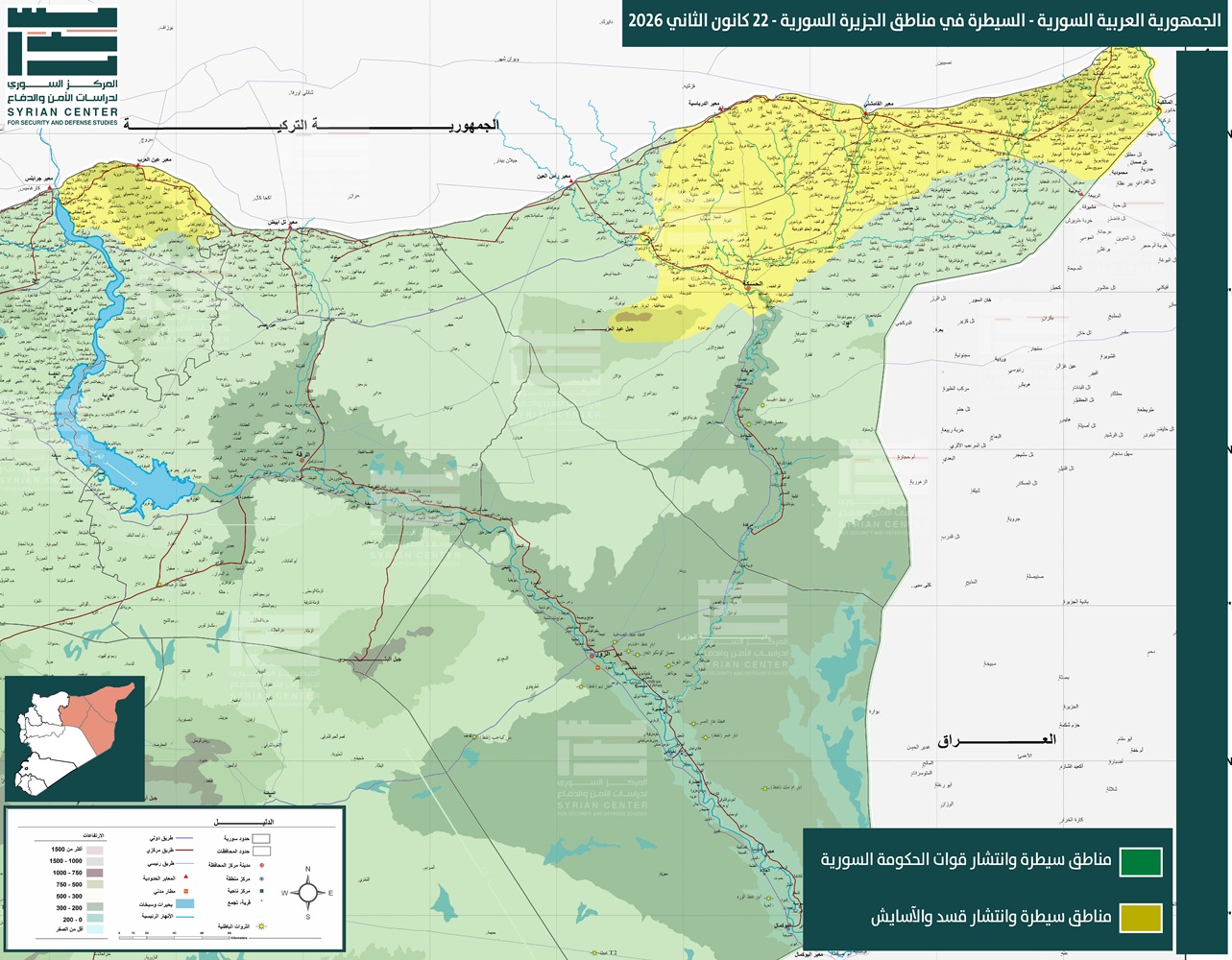
Click to view the map in full resolution
×
![خريطة كاملة]()
100%
Interaction of Local Tribal Forces
The social structure east of the Euphrates is composed of large Arab tribal groupings, most prominently the Aqeedat, al-Baggara, Shammar, Tayy, and al-Jubur, among others, where tribal affiliations intersect with local economic activity (agriculture, trade, and services), as well as with patterns of land and resource control. Over the course of the conflict, these tribes developed shifting relationships with successive authorities: tactical understandings against ISIS during certain phases, followed by intermittent friction with de facto authorities over local security management, resource distribution, recruitment mechanisms, and representation within the Syrian Democratic Forces (SDF). In several Arab-majority areas, this relationship evolved from a “partnership of necessity” into a “crisis of legitimacy,” particularly as the gap widened between local tribal structures and the imposed governance model. This dynamic helps explain the rapid mobilization of segments of tribal communities in support of central state authority once the balance of power appeared to shift against the SDF. Notably, tribal actors had previously attempted to rise against the SDF on multiple occasions, though without significant effect.7.
Tribal forces mobilized across rural areas of Deir ez-Zor that had been under SDF control, coinciding with the Syrian army’s capture of al-Tabqa in the southwestern countryside of Raqqa. These mobilizations followed a phased pattern, beginning in the town of al-Shuhail, then extending to Dhiban, al-Tayyana, al-Hawaij, and Abu Hardoub, before expanding southward toward the towns of Hajin and onward to al-Baghouz, al-Kashkiyah, Abu Hammam, and Gharanij. This progression reflected a pattern of gradual localized control, whereby each tribe assumed authority over areas aligned with its geographic and social sphere of influence in an organized and disciplined manner.8.
On the northern and western banks of Deir ez-Zor, tribal movements in the villages of Marrat, Hatla, and al-Husseiniyah resulted in control over al-Halabiya Roundabout, a strategic junction linking Deir ez-Zor to northern governorates. This development facilitated the reopening of the Deir ez-Zor road toward the city of al-Suwar in the direction of al-Hasakah. Tribal forces also established control over the entire riverine strip, including the villages of al-Hassan, Mahmidah, al-Hawaij, Jadid Baggara, Hawaij al-Bumasa’a, and al-Zugheir, preventing the SDF from redeploying in this sector and compelling its withdrawal toward either al-Hasakah or Raqqa prior to the latter’s capture.9.
The social structure east of the Euphrates is composed of large Arab tribal groupings, most prominently the Aqeedat, al-Baggara, Shammar, Tayy, and al-Jubur, among others.
Tribal forces further consolidated control along the eastern bank of the Euphrates River, including key oil installations in the al-Omar and al-Jafra fields, as well as the Conoco gas processing facility, with support from units affiliated with the Syrian army on 18 January 2026.10 The entry of Syrian army units constituted a pivotal phase in the course of the fighting, as they secured newly captured areas and stabilized frontlines, while tribal forces continued advancing northward toward the towns of Maadan and Markada, reaching the southern approaches of al-Hasakah near the Jibsa gas field, before extending toward al-Hol, Tal Hamis, and al-Ya’rubiyah.11.
Concurrently, Raqqa city witnessed internal mobilizations led by residents, local notables, and tribal blocs operating within the urban environment. These activities gradually established a localized operational presence through the control of specific pockets within certain neighborhoods, capitalizing on the erosion of SDF command cohesion under pressure from multiple fronts. As a result, the city shifted from a closed battlefield environment to a more permeable operational space, where control no longer depended solely on direct confrontation but increasingly on the ability to dominate critical urban nodes, including entry points, intersections, service centers, and local storage facilities.
These internal dynamics were structured around two parallel tracks. The first relied on socio-security infiltration through kinship and tribal networks, enabling the undermining of local checkpoints, the neutralization of certain guard detachments, and the seizure of security facilities within the city. The second focused on encirclement beyond the urban core, exploiting the relative fragility of Raqqa’s rural periphery and securing villages and road junctions that directly influenced supply and mobility routes. This approach effectively reframed the confrontation from a battle within the city to a battle over its surrounding hinterland.12.
Overall, the operational dynamics east of the Euphrates were closely tied to the level of local acceptance enjoyed by the SDF. Evidence from these internal movements indicates that SDF control did not rest on a cohesive social base, rendering its authority structurally vulnerable regardless of its prior military effectiveness. Accordingly, the fragmentation of the SDF governance model east of the Euphrates appears to have resulted less from decisive battlefield superiority than from the cumulative impact of adverse social dynamics that weakened its legitimacy and reduced its capacity to sustain control.
Official and Parallel Media Coverage of the Military Operation
The media environment accompanying military operations west and east of the Euphrates constitutes a key entry point for understanding shifts in the relationship between the military institution and both the public and digital spheres. While official statements consistently projected the image of a “disciplined”13 operation aimed at “restoring security” and “securing borders14,” visual materials and video footage circulated through the personal devices of soldiers and embedded media personnel reconstructed the event outside institutional control channels, exposing inconsistencies in image and discourse management.15.
The media environment accompanying military operations west and east of the Euphrates constitutes a key entry point for understanding shifts in the relationship between the military institution and both the public and digital spheres.
At the level of official media, government coverage of operations west and east of the Euphrates reframed the event as a field-level turning point inaugurating a new phase of “stability” and “counterterrorism,” within a narrative designed to redefine patterns of control and reorder the positioning of key actors. This discourse was structured around three principal themes:
- First: the recapture of territory was redefined as the restoration of state sovereignty over resources and border crossings, and their reintegration into the formal political geography of the state.16
- Second: the army and tribal forces were portrayed as unified national actors confronting “outlaw forces,” transforming tribal participation into a source of locally grounded legitimacy.
- Third: the SDF were re-presented as a temporary actor experiencing declining local representational legitimacy, driven by accusations of external dependency and exclusionary practices along communal lines.17
This narrative construction was reinforced through emphasis on the symbolic value of recaptured locations such as al-Tabqa and the Euphrates Dam, alongside the repeated circulation of images depicting the raising of the national flag and scenes of local residents and tribal groups welcoming advancing forces, framed as evidence of a “return to normal life.18” Within this framework, the Ministry of Defense relied on publishing operational maps illustrating axes of advance, strike coverage, and the boundaries of military objectives. Such visual tools were intended to reinforce the image of planned and regulated operations attentive to lines of contact, civilian presence, and designated safe exit corridors19. Collectively, these elements presented the military institution as a disciplined actor balancing the imperative of security enforcement with the mitigation of collateral harm, consistent with a narrative of a “responsible state” rather than merely a battlefield victor.20.
This narrative also sought to transform the representation of force from an instrument of coercion into an instrument of “protection,” employing language anchored in legality, necessity, and proportionality, and situating the use of violence within declared limits, precision targeting, differentiation between combatants and civilians, and precautionary measures framed as integral to planning rather than reactive responses to criticism. Simultaneously, the discourse managed a legitimacy contest on two levels: addressing domestic audiences concerned about the potential return of disorder or retaliatory violence, while also targeting external audiences monitoring border security, resource protection, and displacement risks. In this sense, “discipline” functioned as both a political message and a military characterization.
visual materials and video footage circulated through the personal devices of soldiers and embedded media personnel reconstructed the event outside institutional control channels.
In contrast, the conduct of certain personnel within the Ministry of Defense, security forces, and accompanying media actors emerged as one of the most sensitive areas of vulnerability. The issue was no longer the availability of recording tools, but rather the everyday media practices carried out spontaneously and outside clearly defined regulatory frameworks. This was reflected in the real-time publication of operational launch sites, footage of vehicle movements21, and at times implicit references to directions of advance and prospective targets22. Such practices indicate limited awareness of operational security requirements and the absence of effective internal enforcement mechanisms capable of translating regulatory instructions into binding field conduct. Consequently, personal social media accounts operated as quasi-unofficial extensions of the military institution, often exerting broader reach and influence than formal channels.
These vulnerabilities extended beyond the exposure of locations to the content of the footage itself. Videos that appeared “routine”, including informal exchanges among personnel, improvised remarks, and displays of weaponry, conveyed unintended signals revealing force size, weapon types, and environmental characteristics23. Footage containing direct threats, retaliatory rhetoric, or derogatory language directed at adversaries or local communities further reshaped the public image of military and security forces in ways that diverged from the official narrative of “discipline” and “civilian protection,” while simultaneously providing adversarial actors with ready-made material to construct hate-driven narratives and intensify social polarization.24.
At the same time, social media platforms emerged as an open arena for competing narratives and divergent interpretations of events. Some tribal and local accounts celebrated what they described as “national cohesion” and a “correction of the balance of control25,” while others expressed concern about the possible re-emergence of earlier patterns of violations, displacement, and arbitrary detention26. The risks associated with this digital space increased further with the proliferation of sensationalized misinformation, particularly narratives framed around alleged “massacres” and “genocide.” In such cases, partial or unverified claims were propelled into public discourse through highly emotive language, often relying on fragmented footage, decontextualized images, or misleading information disseminated by opposing actors. This dynamic generated widespread public anxiety and prompted tribal and local actors to reposition rapidly based on narratives that had not undergone meaningful verification.27.
Within this framework, absent full compliance with behavioral protocols governing field personnel, and without activating these measures through a coherent official communication strategy capable of producing timely, credible, and verifiable narratives, the most widely circulated account of events will remain that shaped by personal mobile devices or by actors most adept at mobilizing fear-based messaging across social networks. At this juncture, the need becomes urgent for an approach that goes beyond regulating the military’s relationship with imagery, toward redefining the role of military and digital media as integral components of the broader contest over legitimacy, representation, and public sphere management, rather than merely technical adjuncts to battlefield operations.28.
Conclusion and Recommendations
The military operations east of the Euphrates in January 2026 reveal a qualitative shift in the nature of military engagement, from confrontation with an organized force to the management of a complex, multi-layered conflict involving local, societal, and media actors. The course of these operations demonstrated that the structural fragility of the Syrian Democratic Forces (SDF) was not solely the result of superior firepower by the Syrian state, but also reflected deeper patterns of social and administrative fragmentation within an environment where local acceptance constitutes a decisive condition for sustainable control.
At the same time, the expanding role of tribal forces, coupled with the growing influence of largely unregulated media spaces, placed the military institution before a dual challenge: maintaining operational discipline on the one hand, while managing the contest over legitimacy on the other. This context underscores the need for multi-dimensional strategies extending beyond conventional military approaches to include local governance tools, media engagement frameworks, and trust-building mechanisms with affected populations.
In light of the current environment, a number of practical measures may be considered to capitalize on existing dynamics, structured as follows:
First: At the Military Level
- With the onset of a de-escalation phase, maintaining operational readiness without creating security vacuums has become a priority, particularly in areas that experienced rapid SDF withdrawals.
- Strengthening the disciplined presence of forces in recently secured areas is advisable, alongside expanding the roles of military police and internal security units to stabilize conditions, protect civilians, and prevent violations that could be exploited by opposing actors for disinformation or incitement.
- The de-escalation period offers an opportunity to reassess force posture along active fronts and redistribute reserve forces in accordance with evolving threat assessments, while avoiding excessive withdrawal or unintended exposure.
Second: At the Social Level (Tribal and Community Dimensions)
- Developments east of the Euphrates reaffirmed the central role of local communities in reshaping control dynamics. The ceasefire environment presents a suitable moment to recalibrate relationships with social constituencies through flexible coordination channels representing influential community figures and local notables.
- Establishing direct communication pathways with tribal actors that actively participated in recent developments, whether through local councils or coordination committees, can help sustain stability and mitigate actions that may erode trust between authorities and local communities.
- Supporting local service and security structures in towns and villages that have recently come under new control reinforces the perception of “liberation as a durable transformation” rather than a temporary phase tied to military presence alone.
Third: At the Media Level
- Media coverage of recent developments demonstrated both its strengths and vulnerabilities. The ceasefire period offers an opportunity to strengthen a unified national communication framework capable of balancing realism with the ability to address both domestic and external audiences.
- Community engagement mechanisms should be developed, including short-cycle local “listening and complaints” channels designed to rapidly counter rumors and reduce the potential for counter-mobilization.
- Consideration may be given to activating a joint military-development media cell tasked with tracking the military, humanitarian, and political effects of operations, thereby enabling official institutions to pre-empt informational disorder during periods of reduced operational tempo.
- Countering hate speech remains critical. This may involve the dissemination of a standardized linguistic and media code of conduct for personnel and embedded correspondents, including clearly defined prohibited expressions and transparent accountability procedures in cases of violation.
- Discipline and accountability mechanisms should be reinforced through the activation of internal reporting channels and the implementation of rapid, transparent investigative procedures into allegations involving harm to civilians or property, with concise public disclosure of findings where feasible.
- Operational security protocols should incorporate unified publication procedures (defining authorized spokespersons, content parameters, and timing), mandatory pre-deployment training, and the linkage of violations to enforceable administrative penalties.