First: Introduction
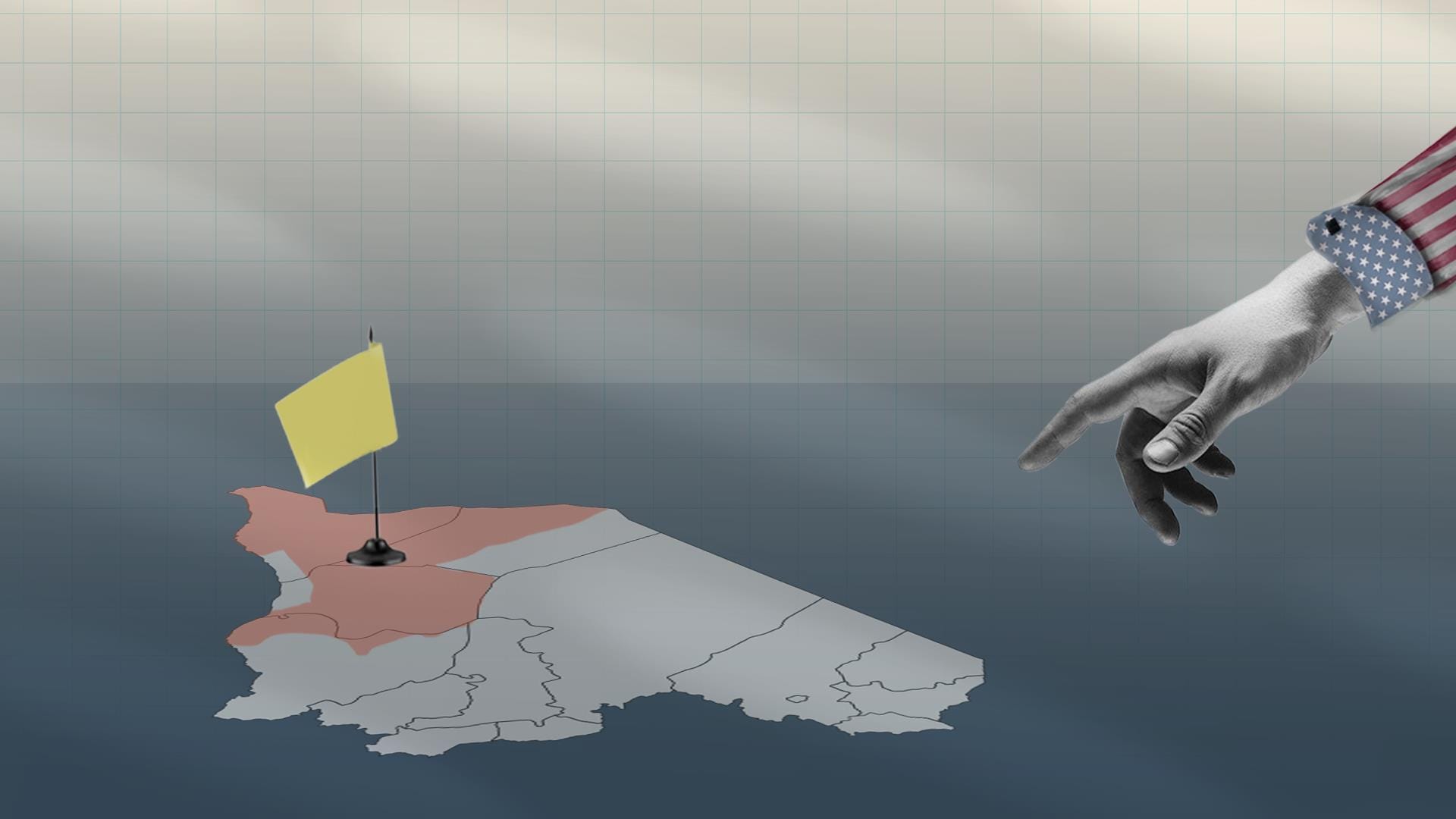
Fourteen years of the Syrian war came to an end with the victory of armed opposition factions and their military removal of the Bashar al-Assad regime by 8 December 2024. Following this victory, and their transition from armed groups into a legitimate governing authority, the new leadership initiated the dissolution of factional military formations and their integration into the emerging military and security structures of the state1. While decisive military operations and coordinated security measures succeeded in dismantling and expelling militias and forces aligned with the former regime, one armed formation retained control over territories that had not been reached by the liberation battles, even though it lost portions of its peripheral areas amid the momentum of advancing operations. This formation was the Syrian Democratic Forces (SDF), supported by the United States and stationed across the Jazira–Euphrates region between the Iraqi border to the east and the Euphrates River to the west. As a result, Syrian territory effectively came to be divided into two principal zones of influence: the first, and by far the larger, under the authority of the new Syrian government, encompassing most of Syrian territory, albeit interspersed with pockets of unrest in Suwayda, the coastal region, and the Syrian Badia; and the second under the control of the Syrian Democratic Forces in the resource-rich northeastern part of the country.
In response to these developments, a negotiation track emerged between the new Syrian leadership and the SDF, as both sides regarded political engagement as a viable alternative to military confrontation, taking into account a range of situational, regional, and international constraints. These negotiations culminated in the signing of an agreement between Syrian president, Ahmed al-Sharaa, and SDF leader Mazloum Abdi on 10 March 2025. The agreement defined the relationship between the U.S.-supported formation and the Syrian state and established a timeline for integrating its forces into the governmental military and security framework2. Subsequently, signs of dissatisfaction began to surface among Syrian government officials regarding the SDF’s failure to comply with the terms of the agreement, accompanied by increasing indications of the possibility of military action3.
Fourteen years of the Syrian war came to an end with the victory of armed opposition factions and their military removal of the Bashar al-Assad regime by 8 December 2024.
Within this context, the present briefing paper examines the principal military dimensions of the SDF, reviewing their organizational structure, core and auxiliary formations, alliances, and the operational and combat experience accumulated over years of engagement. The paper concludes with a set of recommendations considered necessary for the Syrian government’s approach in dealing with this force.
Second: What Are the Syrian Democratic Forces (SDF)?
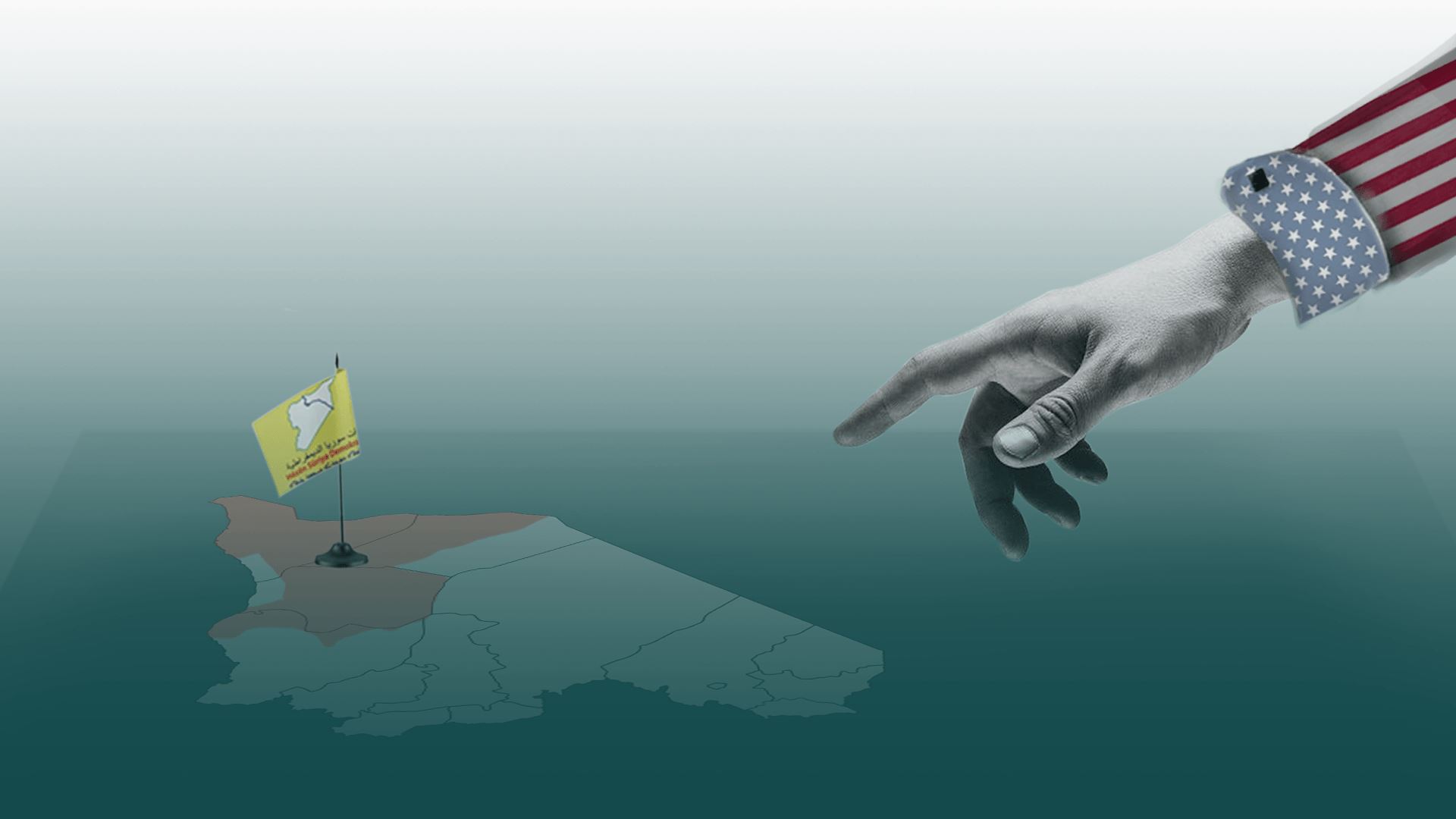
The Syrian Democratic Forces (SDF) constitute a military coalition whose core component is the Kurdish People’s Protection Units (YPG). The coalition includes a number of Arab armed factions with limited leadership influence, as well as smaller Assyrian, Turkmen, and Kurdish formations. It emerged under U.S. sponsorship in the context of the campaign against ISIS in October 20154, and continues to receive U.S. support and backing.
The SDF represents the military wing of a broader governance project led by the Kurdish Democratic Union Party (PYD), known as the Autonomous Administration of North and East Syria5. The People’s Protection Units (YPG), in turn, function as the armed wing of the Democratic Union Party, which maintains organizational ties to the Kurdistan Workers’ Party (PKK)6. The YPG was established in July 2012, drawing its initial command structure from cadres affiliated with the PKK.7.
Third: Command Structure8:
- Military Council
The Military Council constitutes the highest authority within the Syrian Democratic Forces, vested with strategic decision-making powers and responsible for electing the General Commander and members of the General Command. It is composed of representatives from all military factions forming the Syrian Democratic Forces. - General Commander
The General Commander is elected by the Military Council. This position is responsible for presiding over meetings of both the Military Council and the General Command, overseeing the activities of the General Command, and ratifying its decisions during the intervals between Military Council sessions. - General Command
The General Command consists of a group elected by the Military Council, with membership ranging between nine and thirteen individuals depending on operational requirements. Female representation within the General Command is mandatory. This body is responsible for force organization and deployment, as well as for planning, directing, and executing military campaigns.
Military Discipline Committee
This committee consists of five to seven members appointed by the Military Council and is responsible for maintaining discipline among factions and individual personnel.- Administrative Offices
- Relations Office
- Preparation and Training Office
- Media Office
- Records and Archives Office
- Finance, Armament, and Logistics Office
- Military Intelligence Office
- Women Combatants Affairs Office
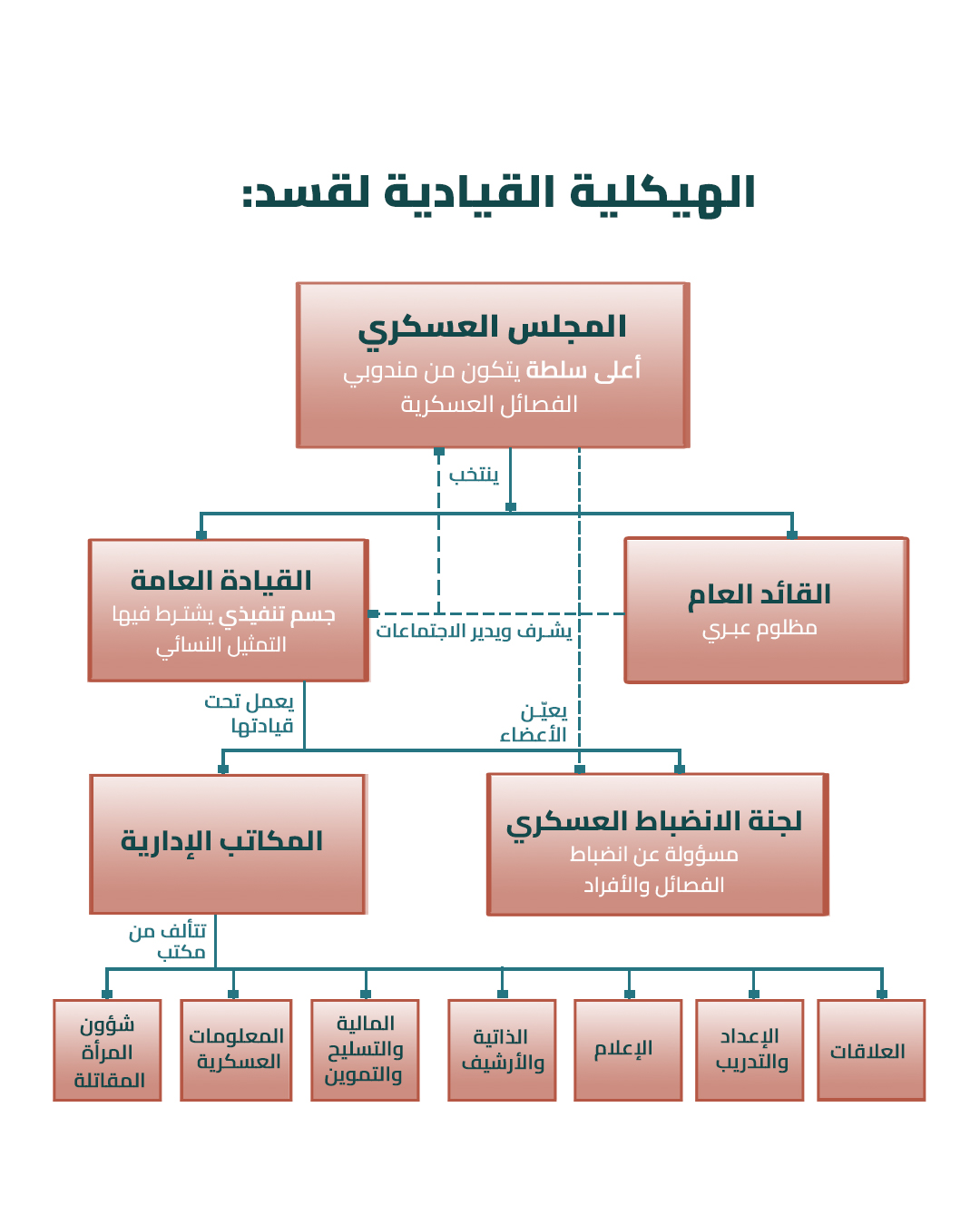
The Syrian Democratic Forces (SDF) constitute a military coalition whose core component is the Kurdish People’s Protection Units (YPG). The coalition includes a number of Arab armed factions with limited leadership influence, as well as smaller Assyrian, Turkmen, and Kurdish formations.
Fourth: Personnel Strength
Statements frequently circulated by SDF leadership figures and officials of the Autonomous Administration assert that their forces number approximately 100,000 personnel9. Among the most recent of these claims was a statement made by SDF Commander Mazloum Abdi in an interview with The Times of London following the fall of the Assad regime.10.
However, the same figure appeared in the Inspector General’s report on Operation Inherent Resolve submitted to the U.S. Congress for the second quarter of 2019, where it referred to the total number of all military and security forces allied in the campaign against ISIS11, of which the SDF constituted only the military component. The report also indicated that the planned strength of the SDF at that time was approximately 30,000 fighters.12 This estimate aligns with a report published by Al Jazeera Net following the fall of the Assad regime, which placed the number of SDF fighters between 20,000 and 30,000. A similar estimate was presented in a research assessment issued by the Harmoon Center in 2020, which placed the total number of SDF personnel, including affiliated security formations, between 26,000 and 33,000.13.
Following the fall of the Assad regime, a wave of defections emerged among SDF personnel toward areas under Syrian government control, reaching several thousand individuals. Most of these defections involved conscripts subject to compulsory service imposed by the Autonomous Administration on young men within its areas of influence, in addition to a number of Arab commanders14. Conversely, the SDF also absorbed a considerable number of officers and personnel from the former Assad regime who fled to territories under its control, incorporating some of them into its ranks.15.
Statements frequently circulated by SDF leadership figures and officials of the Autonomous Administration assert that their forces number approximately 100,000 personnel.
Fifth: Military Formations
The Syrian Democratic Forces (SDF) are fundamentally structured around the military wings of the Democratic Union Party (PYD), with the People’s Protection Units (YPG) at their core. Other armed factions incorporated into the SDF structure can largely be viewed as auxiliary additions and local alliances formed in areas into which the YPG expanded during the campaign against ISIS16 beyond predominantly Kurdish regions. These allied factions were utilized both in combat operations against ISIS and in presenting the PYD’s political project in a pluralistic and ostensibly democratic framework.17
A widely cited statement by U.S. Army General Raymond Thomas underscores the central role of the YPG within the SDF. He noted: “We literally told them [the YPG]: You have to change your name. What do you want your name to be besides the YPG? Within a day, they declared that their name was the Syrian Democratic Forces. I thought using the word ‘democratic’ was brilliant. It gave them some credibility."18.
Reports issued by the U.S. Department of Defense in support of funding allocations under the Counter-ISIS Train and Equip Fund indicate that the SDF consists of several principal formations, including Commando Forces, the Syrian Arab Coalition, the Special Operations Team (formerly designated prior to 2024 as Counter-Terrorism Forces)19 and the People’s Protection Units (YPG)20. Based on available sources, the SDF’s military structure can be categorized into the following principal formations:
- People’s Protection Units (YPG)
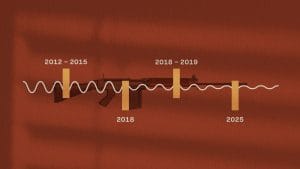
The People’s Protection Units (YPG) constitute the primary armed wing of the Kurdish Democratic Union Party (PYD). Their formation was formally announced on 19 July 2012, coinciding with the withdrawal of Syrian regime forces from the city of Ayn al-Arab (Kobani), although the organization had been operational prior to that date.
The YPG was established and trained by a core group of military cadres affiliated with the Kurdistan Workers’ Party (PKK). It fought its early battles in Ras al-Ayn in late 2012 and early 2013 against formations of the Syrian armed opposition, including Jabhat al-Nusra. The organization gained international prominence during the 2014 Battle of Kobani against ISIS, which drew U.S. attention and led to sustained support and operational cooperation21. Membership in the YPG is not restricted to Kurdish fighters, as Arab personnel are also present within its ranks.22
The YPG is organized according to a hierarchical military structure consisting of five primary levels, with the regiment representing the largest formation: - Women’s Protection Units (YPJ)
The Women’s Protection Units (YPJ) represent the female wing of the YPG, while maintaining an independent organizational identity. Their establishment was announced in the city of al-Malikiyah (Derik) on 4 April 201325. The YPJ maintains representation within the SDF Military Council26. - Commando Forces and Counter-Terrorism Forces (HAT)
U.S. Department of Defense reports collectively refer to these formations as “Finish Forces”27. Plans projected their total strength to reach approximately 1,720 personnel by 2022, including 1,120 commandos and 600 members of the Counter-Terrorism Forces (HAT)28.
Their operational focus centers on counterinsurgency activities. Commando units typically conduct precision raids and clearance operations, while Counter-Terrorism Forces specialize in direct-entry operations targeting insurgent cells in urban environments and confined spaces.29 Functionally, these formations resemble specialized gendarmerie-type forces. Although many sources categorize them as security forces, the presence of a Counter-Terrorism Forces representative within the SDF Military Council30 indicates their integration within the SDF structure. - Syriac Military Council (MFS)
The Syriac Military Council (MFS) is an armed organization affiliated with the Christian Syriac Union Party. Established in 2013, it includes a female branch known as the Beth Nahrain Women’s Protection Forces31. The MFS is among the founding factions of the SDF and operates in neighborhoods of Qamishli and areas within the Hasakah countryside32. It maintains representation within the SDF Military Council33. - Al-Sanadid Forces
Al-Sanadid Forces constitute an armed formation affiliated with the Arab Shammar tribe and its leader, Humaydi Daham al-Jarba. The group operates primarily within Hasakah governorate and was established in 201334. It forms part of the Syrian Arab Coalition involved in the founding of the SDF35 and holds representation within the Military Council.36. - Jaysh al-Thuwar (Army of Revolutionaries)
Jaysh al-Thuwar is a military formation composed of several Arab, Kurdish, and Turkmen factions37. It forms part of the Syrian Arab Coalition involved in establishing the SDF38 and maintains representation within the Military Council39. - Northern Democratic Brigade
Originating from Idlib governorate, this formation withdrew from Idlib in 2015 to Afrin amid clashes with Jabhat al-Nusra, at which point it joined the SDF. Following the loss of Afrin during Operation Olive Branch, the brigade relocated to the Jazira region. The majority of its fighters originate from Idlib governorate40. It maintains representation within the Military Council41. - Military Councils
Military councils represent regionally based formations that consolidate local factions operating within defined geographic zones under unified command structures. This model was intended to reduce factional fragmentation, enhance centralized control, and approximate the organizational characteristics of conventional military forces.
The SDF formally adopted this model in 2019, announcing the establishment of fifteen military councils covering areas under its control as well as regions beyond its operational reach. However, the number of active councils subsequently declined due to the limited effectiveness of some formations42. Existing councils can be identified through membership representation within the SDF Military Council, including:- Jazira Region Military Council
- Tal Tamr Military Council
- Deir ez-Zor Military Council
- Hajin Military Council
- Raqqa Military Council
- Tabqa Military Council
- Tal Abyad Military Council
The SDF is reported to exercise centralized security oversight over military councils through mechanisms operating outside formal command structures. This includes the deployment of Kurdish commanders affiliated with the PKK, locally referred to as “kadro”, across various formations in the capacity of military advisors. These individuals are granted broad authority that at times competes with the formal command authority of local unit leaders, enabling them to oversee both political and military functions within their assigned areas of responsibility.44
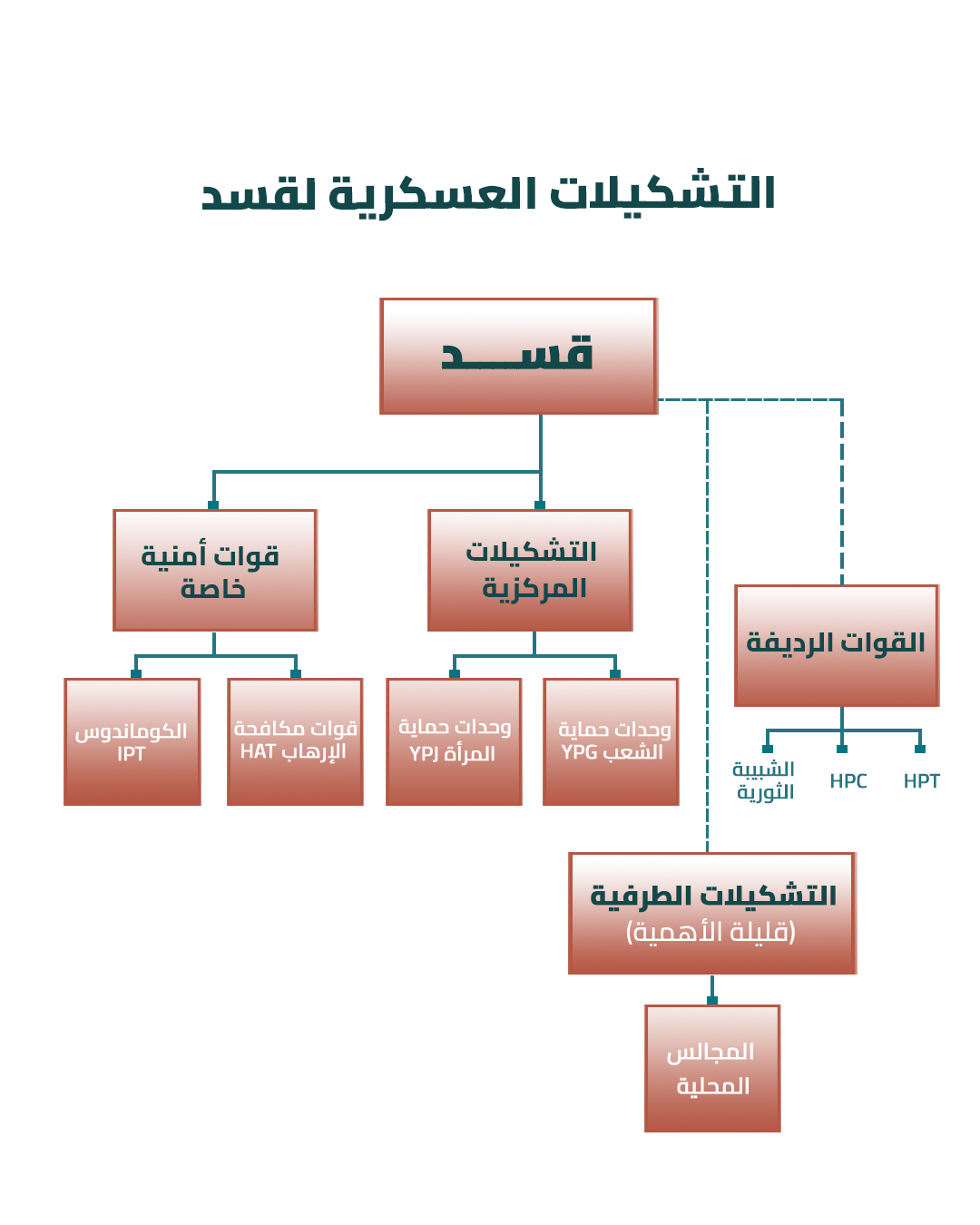
The Syrian Democratic Forces (SDF) are fundamentally structured around the military wings of the Democratic Union Party (PYD), with the People’s Protection Units (YPG) at their core.
Sixth: Auxiliary Forces
Auxiliary forces consist of military, paramilitary, or security formations operating outside the formal organizational structure of the Syrian Democratic Forces (SDF). These formations provide logistical support and serve as a manpower reserve during periods of mobilization and combat escalation, operating under the authority of the Autonomous Administration. The most prominent among them include:
- Self-Defense Forces (HPX)
The Self-Defense Forces (HPX) represent the compulsory service component imposed by the Autonomous Administration on males, subject to certain exemptions45, between the ages of 18 and 30, for a period of one year. These forces are primarily engaged in providing logistical and operational support to SDF units during military activities.46 - Civil Protection Forces (HPC)
The Civil Defense Forces (HPC) consist of civilians who undergo short-term military training and are issued light weapons to defend their cities, towns, and villages during emergencies. This formation was established by the Democratic Union Party (PYD) in 201247. Members of this force may also serve, when required, as local security informants supporting intelligence-gathering activities.48 - Revolutionary Youth
This formation functions as an informal security body composed largely of adolescent members. It is reportedly administered by individuals with military affiliations linked to the Kurdistan Workers’ Party (PKK).49
Seventh: Security Formations
The Syrian Democratic Forces (SDF) are fundamentally a military organization, while security formations operating within their areas of influence are administratively affiliated with the Autonomous Administration50. Nevertheless, these security formations remain armed groups that can be mobilized in support of military operations when required, effectively functioning as auxiliary forces to the SDF.
At the operational level, there is considerable overlap between the SDF and the security bodies affiliated with the Autonomous Administration. All of these entities constitute armed non-state actors, and in practice, there are no clearly defined or consistently enforced boundaries governing their respective authorities. As a result, many sources addressing SDF-related matters incorporate these security formations within the broader SDF framework.
All security formations operating in areas under SDF control are generally grouped under the designation Asayish51. However, documents issued by the U.S. Department of Defense classify security forces within SDF-controlled areas into two principal categories: Internal Security Forces and Regional Internal Security Forces52, the latter functioning in a role broadly comparable to gendarmerie-type forces.
The Syrian Democratic Forces (SDF) are fundamentally a military organization, while security formations operating within their areas of influence are administratively affiliated with the Autonomous Administration.
Eighth: Alliances
The most significant strategic alliance of the Syrian Democratic Forces (SDF) is with the United States, which sponsored their formation53 and allocates funding to them through the U.S. Department of Defense budget under the Counter-ISIS Train and Equip Fund. Pentagon documentation indicates that the United States provides the SDF with ammunition, light and medium weaponry, logistical support, non-lethal equipment, monthly stipends, and military and security training54, in addition to intelligence support and ISR (Intelligence, Surveillance, and Reconnaissance) capabilities55.
This support is further reinforced by the deployment of U.S. forces and military bases across areas under SDF control56, alongside a stated U.S. commitment to defending territories east of the Euphrates, except in the case of the limited Turkish Operation Peace Spring, which was preceded by intensive U.S.–Turkish coordination57. Accordingly, characterizing the SDF as a U.S. proxy in Syria is not without analytical basis.
Beyond this primary alliance, the SDF has established tactical and situational partnerships with several other actors. This includes cooperation with Russia, to which the SDF permitted the establishment of military bases within its areas of control following the Turkish Operation Peace Spring. This cooperation continued even after the fall of the Assad regime58, though it has remained constrained by U.S. strategic sensitivities.59
Following the fall of the Assad regime, the SDF also demonstrated openness to engagement with Iran60 and Israel61 on selected issues. The trajectory of these relationships, whether toward expansion or contraction, remains contingent upon broader geopolitical shifts.
Ninth: Combat Experience
The combat experience of the Syrian Democratic Forces (SDF) can be traced across two principal phases: the first being a preparatory and experimental phase characterized by alliance-building and operational testing prior to the formal establishment of the SDF; and the second representing the period of the SDF’s official institutional presence.
1. Preparatory Phase:
- Battle of Kobani (Ayn al-Arab), 2014–2015: This battle took place between ISIS, during its territorial expansion, and the People’s Protection Units (YPG). Although it preceded the formal establishment of the SDF, it served as the catalyst for its creation and functioned as a foundational operational model and testing ground.
ISIS launched a military offensive on the city of Ayn al-Arab (Kobani) on 13 September 2014, advancing steadily until it imposed a full siege on the city and penetrated several of its neighborhoods. At that stage, YPG forces were reinforced by factions from the Syrian armed opposition and units of the Peshmerga forces of the Kurdistan Region of Iraq, which entered via Turkish territory with the approval of the Turkish government. The battle also saw extensive participation by coalition air forces. It concluded with the defeat of ISIS and its withdrawal from the city on 15 March 2015.62 - Battle of Tal Abyad, 2015: This offensive was led by the People’s Protection Units (YPG) at the head of an alliance of factions operating under the Euphrates Volcano Operations Room in May 2015, aiming to seize the border town of Tal Abyad from ISIS.
The battle followed the win in Kobani and sought to capitalize on elevated morale and the operational momentum generated by allied coordination. It involved similar patterns of coalition-based field alliances and sustained air support from coalition aircraft. Unlike the defensive nature of the Kobani battle, however, this engagement was primarily offensive in character.
The battle concluded in August 2015 with the capture of the entire border strip extending from Kobani in the west to al-Malikiyah (Derik) in the east.63
The Battle of Tal Abyad marked the beginning of ISIS’s territorial contraction and represented a decisive stage in the maturation of the concept underlying the formation of the Syrian Democratic Forces. The formal announcement of the SDF’s establishment followed less than two months after the battle, with several factions from the Euphrates Volcano Operations Room among the founding components of the new formation.
The Battle of Tal Abyad marked the beginning of ISIS’s territorial contraction and represented a decisive stage in the maturation of the concept underlying the formation of the Syrian Democratic Forces.
2. The SDF Phase:
Following the announcement of the formation of the Syrian Democratic Forces (SDF), the United States moved swiftly to provide support through weapons, ammunition, military training, and capacity-building programs, later supplemented by the deployment of military advisors to enhance operational coordination and planning64. This assistance coincided with an escalation in coalition airstrikes targeting ISIS positions65. Collectively, these measures significantly enhanced the SDF’s strategic, operational, and tactical capabilities, as reflected in the major engagements outlined below.
- Battles and Military Campaigns Against ISIS: From its establishment in October 2015 until the defeat of ISIS in March 2019, the SDF conducted successive military campaigns against the organization. The United States played a central, if not decisive, role in these operations.66
The following represent the most significant battles and military campaigns undertaken during this period:- Battle of al-Hol (2015): This battle lasted approximately two weeks, from 30 October to 13 November 2015. During the operation, SDF forces advanced through the southern countryside of Hasakah governorate, ultimately securing control of the strategically significant town of al-Hol67. The operation coincided with Iraqi military operations against ISIS in the Sinjar region, located opposite southern Hasakah along the Iraqi border68.
- Battle of Tishrin Dam (2015): On 23 December 2015, the SDF launched an offensive from the southern outskirts of Ayn al-Arab (Kobani), capturing the eastern bank of the strategically important Tishrin Dam on the Euphrates River within three days. The dam represented a critical gateway toward Manbij and the northern Aleppo countryside from the east69. Two days later, SDF forces secured the western bank, marking the first time the SDF crossed the Euphrates River from east to west70.
- Battle of al-Shaddadi (2016): On 16 February 2016, the SDF launched a coordinated offensive involving approximately 6,000 fighters targeting the city of al-Shaddadi in southern Hasakah. The operation proceeded along two primary axes: from the northwest via the Abd al-Aziz mountain range, and from the northeast via al-Hol. The battle lasted nine days and concluded with the capture of the strategic city and surrounding territory from ISIS.
During this engagement, the SDF demonstrated awareness of local ethnic sensitivities, as the area was predominantly Arab and tribal in composition. Accordingly, between one-half and two-thirds of the attacking force consisted of Arab fighters. This battle also marked the first instance of direct field participation by U.S. military advisors71. - Battle of Manbij (2016): Among the most significant and operationally complex engagements to date, this battle began with a diversionary attack targeting Raqqa from the north to draw ISIS attention toward its administrative center and disperse its forces.
The Manbij offensive commenced on the night of 1 June 2016. Approximately 800 fighters crossed the Euphrates River near the damaged Qara Qozak Bridge, while an additional 1,500 fighters crossed via the Tishrin Dam under intensive air and artillery support. The advancing forces secured positions on the western bank and facilitated the crossing of additional reinforcements via temporary bridges constructed for the operation.
By 11 June 2016, the attacking forces had encircled Manbij. Intense combat continued for two months until ISIS forces surrendered and were permitted to withdraw toward Jarablus on 12 August 201672. Arab formations constituted approximately two-thirds of the attacking force during this battle.73 - Capture of Raqqa (Wrath of the Euphrates Campaign), 2016–2017: This campaign represented the most significant operation against ISIS and lasted approximately one year, beginning on 5 November 2016 and concluding on 20 October 2017. It was planned at both strategic and operational levels under U.S. leadership.74 The campaign can be divided into two principal phases:
- Isolation of Raqqa: This phase aimed to create the strategic conditions necessary for the capture of ISIS’s capital. The SDF advanced along three primary axes toward Raqqa: From the north via Ayn Issa, from the northwest via Manbij and the Tishrin Dam, and from the northeast via Hasakah.
These operations continued for approximately seven months, concluding in late May 2017. Key achievements included the capture of al-Tabqa city and the Euphrates Dam. By the end of this phase, SDF forces had encircled Raqqa from the north, east, and west. During this period, U.S. ground troop presence increased, and the SDF conducted its first airborne assault operations using U.S. aircraft75. - Assault on Raqqa (2017): More than 35,000 fighters were mobilized for the assault on Raqqa as part of a military campaign planned under the Combined Joint Task Force, Operation Inherent Resolve, led by the United States.
The campaign began on 6 June 2017 and unfolded across five operational phases over approximately four and a half months. It concluded on 20 October 2017 with a negotiated settlement allowing ISIS fighters and their families to withdraw from the city while retaining their weapons and ammunition, following sustained resistance inside Raqqa despite a prolonged siege that lasted nearly four months from 24 June 2017 onward.
Coalition participation included between 3,000 and 5,000 personnel from U.S. and allied Western forces, including approximately 500 U.S. Special Forces personnel, alongside British, German, and French special operations units. The campaign also relied heavily on sustained air and artillery support.76 SDF losses during the battle exceeded 650 fighters.77
- Isolation of Raqqa: This phase aimed to create the strategic conditions necessary for the capture of ISIS’s capital. The SDF advanced along three primary axes toward Raqqa: From the north via Ayn Issa, from the northwest via Manbij and the Tishrin Dam, and from the northeast via Hasakah.
- Battle of al-Baghouz (2019): This engagement marked the final battle between the SDF and ISIS. It followed a series of major SDF advances across eastern Deir ez-Zor governorate that forced ISIS fighters into an increasingly confined enclave centered around the town of Hajin in southeastern Deir ez-Zor.
SDF forces continued their advance until ISIS fighters were ultimately encircled in the town of al-Baghouz al-Fawqani, which became the last major concentration point for ISIS personnel in Syria, effectively transforming into a densely populated tent settlement.
The offensive against al-Baghouz began on 9 February 2019 and concluded on 23 March 2019 with the surrender of ISIS forces and the collapse of the organization’s territorial presence in Syria.78
- Engagements Against Turkey and Allied Forces: The SDF engaged in two major confrontations against Syrian opposition formations supported and led by the Turkish Armed Forces. In both cases, the SDF operated primarily in a defensive capacity and ultimately sustained territorial losses.
- Operation Olive Branch (2018): On 20 January 2018, Turkish Armed Forces, supported by factions of the Syrian National Army, launched a military operation against SDF positions in the Afrin canton in northwestern Syria, an area covering approximately 1,750 square kilometers.79 The attacking force included approximately 7,000 Syrian opposition fighters supported by around 1,000 Turkish soldiers, along with extensive air and artillery support, facing an estimated 8,000 to 10,000 SDF fighters.80
After approximately two months of combat, the attacking forces captured Afrin city and most of the canton’s territory. The full campaign lasted nearly four months and concluded with the complete removal of SDF forces from the Afrin enclave81. The United States declined to provide direct support to the SDF during this operation. - Operation Peace Spring (2019): As in its predecessor, on 9 October 2019, Turkish forces and allied Syrian National Army formations launched a military operation targeting SDF positions along the border regions east of the Euphrates.
The operation resulted in the capture of a border strip exceeding 100 kilometers in length, extending from Tal Abyad in northern Raqqa countryside to Ras al-Ayn in Hasakah countryside, with an approximate depth of 30 kilometers.
The campaign lasted approximately five weeks and concluded with a Turkish–Russian political agreement after the SDF sought Russian mediation following the withdrawal of U.S. forces from the operational zone prior to the launch of the offensive82.
- Operation Olive Branch (2018): On 20 January 2018, Turkish Armed Forces, supported by factions of the Syrian National Army, launched a military operation against SDF positions in the Afrin canton in northwestern Syria, an area covering approximately 1,750 square kilometers.79 The attacking force included approximately 7,000 Syrian opposition fighters supported by around 1,000 Turkish soldiers, along with extensive air and artillery support, facing an estimated 8,000 to 10,000 SDF fighters.80
- Confrontation with Wagner Forces (2018): On the evening of 7 February 2018, approximately 500 fighters affiliated with the Russian private military company Wagner, alongside pro-regime forces, launched an attack against the Conoco gas facility in Deir ez-Zor countryside, an area under SDF control and guarded jointly with U.S. personnel.
U.S. forces initially employed warning artillery fire and attempted for approximately fifteen minutes to contact Russian regular forces through established deconfliction channels, but received no response. U.S. air power subsequently engaged the attacking force, concluding the engagement within approximately two hours and inflicting an estimated 100 to 300 casualties. SDF participation in this engagement was limited.83 - Tribal Uprising (2023): Clashes erupted between the SDF and the Arab Aqeedat tribe in late August 2023 across northern and eastern Deir ez-Zor countryside. The SDF initially suffered losses but regained control after approximately two weeks of fighting, as the tribal uprising failed to secure political backing or sustained external support.84
Among the formations most heavily deployed by the SDF in suppressing the uprising was the Northern Democratic Brigade, whose fighters are primarily of Arab origin but not affiliated with local tribal structures and largely originate from Idlib governorate.85 - Syrian Liberation Battles (2024): With the launch of the Deterrence of Aggression campaign, which culminated in the fall of the Bashar al-Assad regime and the entry into Damascus on 8 December 2024, armed opposition formations initiated a parallel campaign from northern Aleppo countryside under the designation Dawn of Freedom (Fajr al-Hurriya). This campaign targeted areas across Aleppo governorate, including territories under SDF control.
Clashes occurred between the two sides in the Tal Rifaat enclave, the Manbij region, and eastern and southern Aleppo countryside, where the SDF advanced following the withdrawal of Assad regime forces. These engagements resulted in SDF losses, including the loss of Manbij and the Tal Rifaat enclave86, while retaining a limited foothold in the Ashrafieh and Sheikh Maqsoud neighborhoods of Aleppo city.87
New lines of contact were subsequently established in southern Aleppo countryside, with intermittent clashes continuing between SDF forces and the newly formed Syrian army even after the signing of the 10 March agreement.88
On a separate front, forces participating in the Deterrence of Aggression campaign attempted to cross the Euphrates River in Deir ez-Zor governorate into SDF-held areas. Coalition aircraft conducted low-altitude overflights above advancing units, signaling opposition to the crossing attempt89.
From its establishment in October 2015 until the defeat of ISIS in March 2019, the SDF conducted successive military campaigns against the organization.
Tenth: Conclusion and Recommendations
The Syrian Democratic Forces (SDF) have now completed a decade of operational existence, during which they have established themselves within the Syrian landscape as one of the most entrenched actors to emerge from the years of conflict. Following the fall of the Assad regime, the SDF remain the only armed formation continuing to contest the sovereignty of the new Syrian state within its areas of influence. Over the course of their development, the SDF accumulated substantial combat experience, engaging in numerous battles against both conventional forces and irregular formations, as well as mixed-force coalitions. They have participated in joint operational maneuvering alongside regular forces, played a central role in the territorial defeat of ISIS in Syria, and demonstrated a notable degree of strategic organization by consolidating diverse armed groups around the central command structure of the People’s Protection Units (YPG), in addition to maintaining extensive security operations across multiple domains.
Their most significant strategic advantage, and the primary factor underpinning their continued durability, remains the protective umbrella provided by the United States, which has elevated them into a regional actor capable of serving as an operational partner for multiple stakeholders seeking to advance their interests in the area.
Recommendations:
- Enhance security and intelligence operations aimed at widening internal fractures among SDF components and neutralizing selected elements, given the existence of multiple internal divergences within the coalition structure.
- Develop an effective information strategy capable of influencing SDF rank-and-file personnel and reducing levels of public support in areas under their control.
- Reassess negotiation tracks sponsored by the United States, as these may function as instruments of strategic delay, given that the SDF remains the U.S. proxy in the region and a more reliable partner for the United States than the newly established Syrian government.
- Activate special operations capabilities behind contact lines to maintain sustained operational pressure on SDF positions.
- Undermine the SDF’s claim to represent Kurdish constituencies by permitting broader cultural expression among Kurdish communities, including outside their traditional areas, and supporting independent Kurdish platforms and public figures not aligned with nationalist hardline currents.
- Promote a model of effective governance within Syria that attracts civilian populations in SDF-controlled areas toward engagement with the Syrian government, thereby increasing public dissatisfaction with SDF administrative structures.