Executive Summary
Hybrid warfare has emerged as a prominent feature of modern conflict, employed by both formal and non-state actors. Within the context of the Syrian conflict (2011–2024), this pattern of warfare has fostered the emergence of hybrid weapons, developed primarily to meet pressing battlefield needs. Syrian revolutionary factions played a significant role in revitalizing the sector of hybrid firearms, which reached its peak between 2017 and 2018. During this period, several weapons systems were developed, contributing positively to the factions’ military effectiveness at both the tactical and strategic levels.
After examining the most significant hybrid firearms used by these factions and analyzing the technical inputs underlying their hybridization, this paper proposes a set of recommendations aimed at advancing this sector in light of the continuing operational need for it. These recommendations include establishing a dedicated body within the armament administration to oversee and govern the sector, attracting specialists and technical personnel who worked in this field throughout the years of conflict (2011–2024), and creating a specialized unit to examine experiences from countries that have experienced hybrid warfare. Such comparative analysis would help generate valuable insights and support the further development of this sector in Syria.
Hybrid warfare has emerged as a prominent feature of modern conflict, employed by both formal and non-state actors.
Introduction
The Syrian conflict (2011–2024) has served as a distinctive field within the broader framework of hybrid warfare. The dynamics of the conflict gave rise to hybrid weapons, largely driven by urgent operational requirements on the battlefield. These developments were closely tied to the evolving nature of the conflict, the diversity of actors involved, and the severe constraints in resources and armaments. In response, Syrian revolutionary factions developed an array of hybrid weapons to adapt to these conditions. By 2017, hybridization efforts had reached their peak, significantly enhancing the factions’ operational performance and effectiveness at both the tactical and strategic levels, in defensive as well as offensive contexts. In several cases, factions were also able to alter the functional identity of existing weapons systems and repurpose them to suit their operational needs.
Against this background, the present paper seeks to provide a comprehensive overview of the phenomenon of hybrid weapons among Syrian revolutionary factions. It analyzes the underlying motivations behind the spread of this category of weaponry, assesses its impact on military performance and effectiveness, and offers a set of recommendations aimed at improving governance frameworks and advancing the processes involved in the development and production of these weapons.
The importance of developing the hybrid weapons sector must be understood in light of the evolving nature of modern warfare. Contemporary conflicts have increasingly moved away from traditional models based on symmetrical threats, giving way to newer forms of warfare as both state and non-state actors adopt strategies such as proxy warfare and hybrid warfare. This shift reflects a broader transition from confronting symmetrical threats to managing asymmetrical threats. Modern conflicts—such as the Russia–Ukraine war and the Israel–Palestine conflict in Gaza—demonstrate the hybrid character of contemporary warfare and its reliance on innovative operational tools. Accordingly, careful management of the hybrid weapons phenomenon in Syria, alongside efforts to further develop this sector, has become increasingly necessary in light of the growing tendency of power structures to rely on hybrid forms of warfare.
This paper focuses specifically on hybridized automatic firearms, without addressing the comprehensive manufacturing processes of artillery systems or light and heavy sniper rifles. Instead, the study concentrates on the dimension of local innovation in this particular category of weapons as a means of assessing factional capabilities and evaluating the effectiveness of these weapons in comparison with other factors such as sustainability and tactical impact.
Hybrid Weapons in the Syrian Conflict: Causes and the Framework of Adaptation
Hybrid weapons can be defined as composite weapon systems that integrate elements of conventional and unconventional arms, developed under battlefield conditions characterized by limited resources in order to enhance military effectiveness and adapt to the evolving nature of conflict. These weapons include light automatic firearms as well as medium and heavy machine guns.
Hybrid weapons can be defined as composite weapon systems that integrate elements of conventional and unconventional arms, developed under battlefield conditions characterized by limited resources.
Following the territorial gains achieved by revolutionary factions between 2011 and 2014, when their operations largely relied on guerrilla warfare tactics, the Syrian regime sought to draw these factions into the dynamics of conventional open warfare. The Syrian army, being a traditional force trained primarily for conventional operations, faced limitations in urban warfare due to the heavy nature of its armament. In contrast, opposition factions possessed greater flexibility and mobility.
Beginning in early 2015, the Syrian government succeeded in pushing revolutionary factions into conventional open engagements, particularly in southern rural Aleppo and Eastern Ghouta1. The imbalance in military capabilities and armaments—combined with the direct intervention of Russian forces—led to a gradual decline in the operational position of opposition factions and the loss of significant territories previously under their control2.
Hybrid weapons can be defined as composite weapon systems that integrate elements of conventional and unconventional arms, developed under battlefield conditions characterized by limited resources.
This deterioration in battlefield performance prompted a process of strategic reassessment among revolutionary factions regarding both their combat doctrines and the nature of the military tools at their disposal. As a result, factions such as Hayat Tahrir al-Sham and Ahrar al-Sham Islamic Movement, alongside several other groups, began establishing small, specialized units. These units relied on hybrid weapons, advanced mixed training programs, and intensive psychological and physical preparation.
By late 2017, efforts to develop these specialized formations had reached their peak as factions underwent a broader operational transition. Rather than confronting Syrian government forces, Russian units, and allied militias through conventional means, these groups increasingly adopted non-conventional tools and tactics.
Within this framework, Hayat Tahrir al-Sham established the “Red Bands” (al-Asa’ib al-Hamra)3 units, which function as an elite strike force relying on hybrid weapons and unconventional tactics. Similarly, “al-Maghawir” forces within Ahrar al-Sham Islamic Movement, as well as comparable units within Harakat al‑Tahrir wa al‑Binaa, and the training group Malhama Tactical4, represent examples of professional formations whose armament and training have been structured around unconventional operational doctrines5.
In practical terms, revolutionary factions moved almost entirely beyond the phase of conventional warfare toward hybrid warfare6, particularly after the 2019 military campaign conducted by Russian forces in coordination with the Syrian government and allied militias against the towns of al-Habit in southern Idlib countryside and Kafr Nabudah in northern Hama countryside7. The advance of Russian-backed forces toward opposition-held territories was slowed in part due to the intervention of elite formations such as the Red Bands and al-Maghawir units, alongside smaller specialized groups from other factions.
revolutionary factions moved almost entirely beyond the phase of conventional warfare toward hybrid warfare, particularly after the 2019 military campaign conducted by Russian forces.
Key Types of Hybrid Weapons Used by Revolutionary Factions and Their Effectiveness
Revolutionary factions developed various forms of conventional light individual weapons as well as medium and heavy machine guns by altering their original functional configuration. This process involved integrating conventional weapons with non-conventional components or operational modifications, resulting either in fully hybridized integrated systems or in weapons adapted for use in ways that differ from their traditional modes of deployment, whether in terms of mounting, targeting, or operational function.
| Technical Specifications of the Weapon | KALASHNIKOV AK 47 | AK-74 Assault Rifle | PK General-Purpose Machine Gun (GPMG) | Heavy Machine Gun 38/46 (DSHK 38/46) | Vladimirov Heavy Machine Gun (KAP) | Anti-Aircraft Heavy Machine Gun. ((ZU-23MM-2B (ZU-23MM-2B) |
|---|---|---|---|---|---|---|
| Caliber | : 7,62-39 mm | 4,45 | 7,62 mm | 12,7 mm -100mm | 14,50 mm -114 mm | 23 mm. |
| Dimensions | Length: 86.8 cm | Overall Length: 93 cm | Length: 116 cm | Length: 158.5 cm | Length: 200 cm | Length: 5.7 m |
| Barrel Length | 41،4 cm | 65.5 cm | 107 cm | 41،4 | - | - |
| Weight | 4 kg | 3,6 kg | 8,9 kg | 35,5 kg | 51 kg | 950 kg. |
| Effective Range | 400 m | - | 1000 m | 2000 m | 2500 m | 2,500 m |
| Operating Mechanism | Gas-operated, selective fire | Gas-operated, selective fire | Gas-operated | Gas-operated | Recoil-operated | - |
| Muzzle Velocity | 710 m/s | 900 m/s | 825 m/s | 860 m/s | 900 m/s | 2,000 rounds per minute |
| Bolt | Covered projecting front bolt | Covered projecting front bolt | Projecting front bolt with locking lugs | Projecting front bolt with locking lugs | - | - |
| Rear Sight | Tangent | Tangent | - | Thin tangent rear sight | - | - |
| Magazine | Detachable box magazine (30 rounds) | Detachable polymer box magazine (40 rounds) | Ammunition belt (50, 200, or 250 rounds) | Linked ammunition belt (50 rounds) | Detachable box magazine (30 rounds) | - |
| Theoretical Rate of Fire | 600 rounds per minute | 650 rounds per minute | 650 rounds per minute | 540–600 rounds per minute | 600 rounds per minute | 2,000 rounds per minute |
| Hybridization Inputs | Conversion from iron sights to telescopic aiming devices, with the addition of both day and night scopes, enabling enhanced targeting capability in support of attacking and defending infantry units. | Integration of optical systems, replacing iron sights with telescopic aiming devices and equipping the weapon with day- and night-vision optics to improve accuracy and battlefield support for infantry operations. | Integrated modifications, including the installation of telescopic optics with day–night capability, as well as the addition of a sound suppressor and flash hider for night operations. The weapon’s mode of employment was also modified—from a mounted automatic support weapon to a man-portable system used by infantry units. It is employed in both offensive and defensive roles to provide fire support and covering fire, and its barrel has also been adapted for use in locally manufactured sniper platforms. | Integrated enhancements involving the replacement of iron sights with telescopic optics and the addition of night-vision capability. The mounting configuration was also modified—from a towed, fixed-position gun to a weapon mounted on four-wheel-drive vehicles and motorcycles, and in some cases carried by personnel. Its operational role was shifted from an anti-aircraft weapon to a system used against infantry and armored vehicles, providing fire support to infantry units in both defensive and offensive engagements. | Adaptation of the transport configuration, transforming the weapon from a towed, fixed gun into one mounted on four-wheel-drive vehicles. Its role was likewise adapted from anti-aircraft use to engagement of infantry and armored vehicles, serving as direct fire support for infantry forces during both defensive and offensive operations. | Adaptation of the mobility and deployment system, converting the weapon from a towed, ground-mounted platform into one mounted on four-wheel-drive vehicles. Its operational function was expanded from anti-aircraft use to a multi-role weapon capable of engaging infantry, armored and unarmored vehicles, and destroying fortifications and defensive positions. It is also used to provide preparatory and supporting fire in both confined and open battlefields, during offensive and defensive engagements. |
Table (1): Key Types of Firearms Hybridized by the Revolutionary Factions8
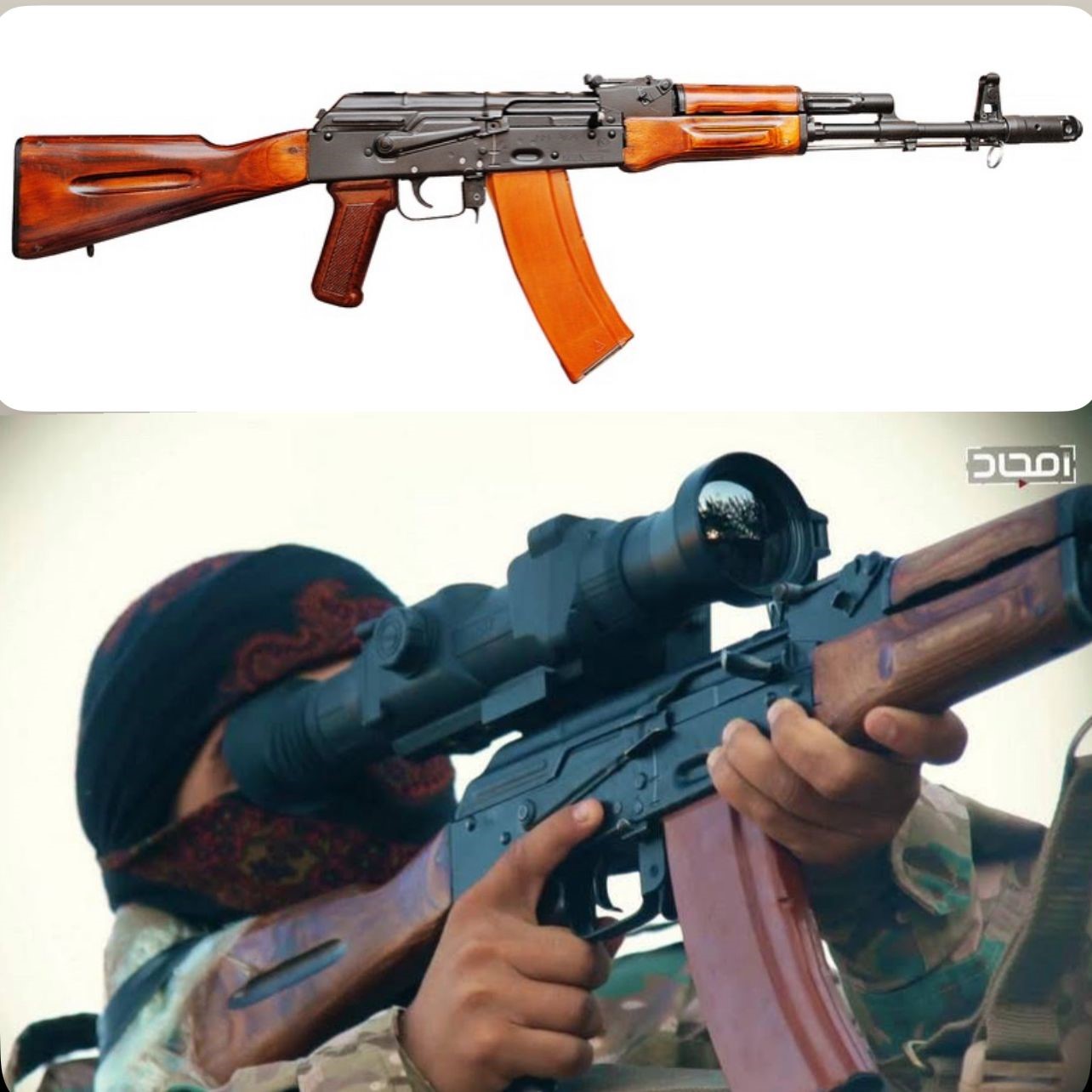
Image illustrating the hybridization inputs applied to the AK-74 machine gun.
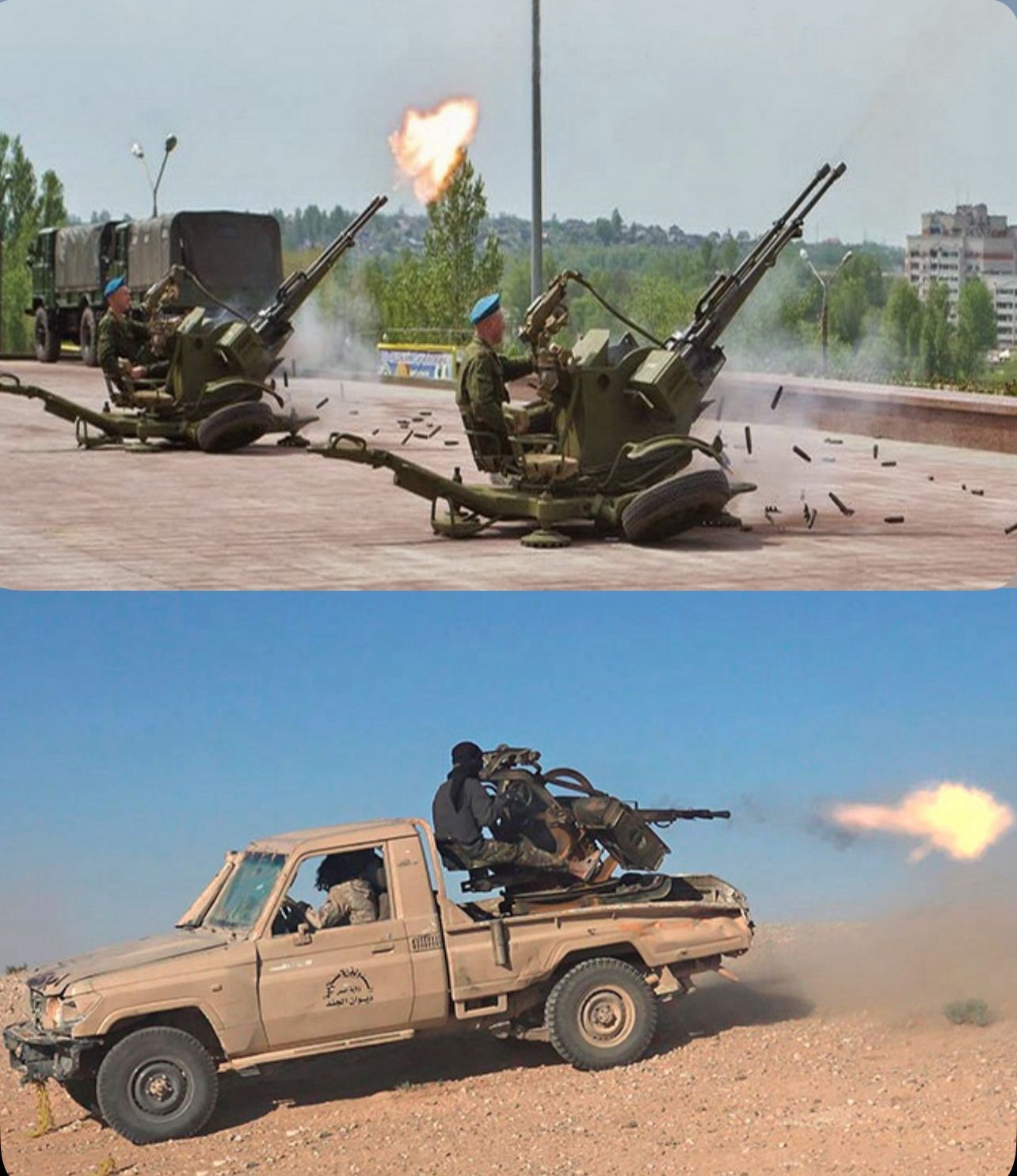
Image illustrating hybridization through altering the functional role of the 23 mm machine gun, by converting its mode of deployment from a towed weapon to a mobile-mounted system.
Revolutionary factions developed various forms of conventional light individual weapons as well as medium and heavy machine guns by altering their original functional configuration.
An analysis of field data on the effectiveness of these hybrid weapons indicates that they provided frontline combat units with greater maneuverability and mobility across both urban and open terrains. This capability made them a distinctive tactical tool in the hands of revolutionary factions, enabling them to influence the outcome of engagements in both defensive and offensive operations. Their impact was particularly evident during the confrontations between opposition factions and Russian forces in 2019, as well as during the “Deterrence of Aggression” battle9.
These weapons also demonstrate the factions’ capacity to adapt to limited available resources and unconventional conflict environments, reflecting a notable degree of local innovation. Such innovation emerged largely as a response to constraints in armament supplies and limited external support10, prompting factions to develop improvised yet operationally effective solutions.
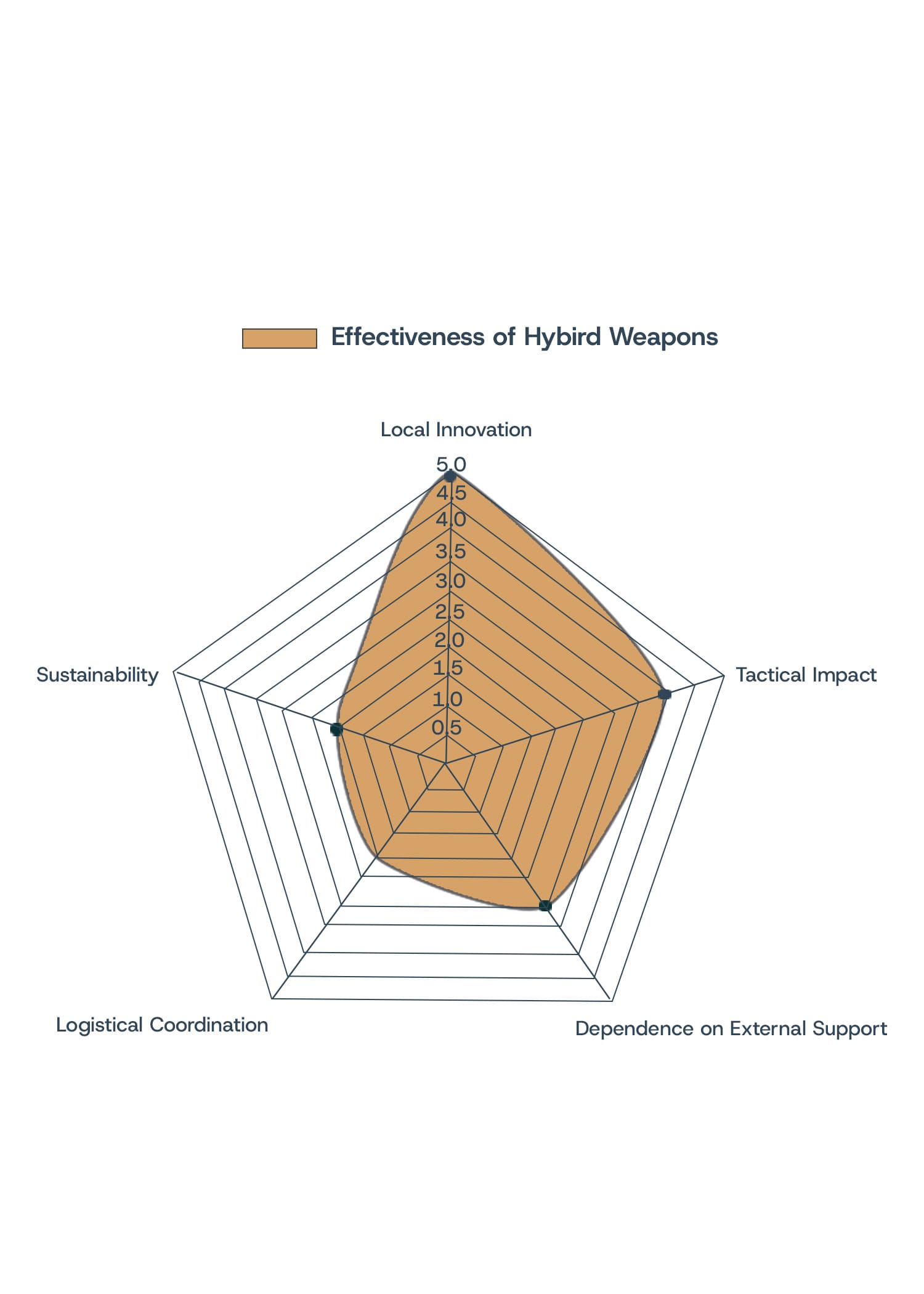
Figure (1): Radar chart illustrating an evaluation of the effectiveness of hybrid weapons across multiple criteria.
The radar chart analysis is based on comparing several key indicators through an examination of multiple field operations and an assessment of the effectiveness of hybrid weapons. The findings indicate that local innovation recorded the highest level of effectiveness, significantly reducing the factions’ reliance on external support. Tactical impact ranked second in the comparative assessment, reflecting the operational influence of these weapons in battlefield engagements. By contrast, the sustainability of hybrid weapons production scored notably lower, highlighting the structural limitations affecting the long-term continuity of this sector.
Recommendations
The emergence of hybrid weapons within the context of the Syrian conflict presents both challenges and opportunities for the Syrian government. These challenges operate on two primary levels. The first concerns security governance, particularly the ability to regulate and control the proliferation of such weapons. The second relates to development and production, specifically how these weapons might be incorporated into the arsenals of the Ministry of Defense and the country’s security institutions.
The widespread presence of hybrid weapons, facilitated by their relative ease of manufacture, distribution, and promotion, as well as by the existence of semi-regular armed actors possessing such systems, poses potential risks to security and stability. This concern is particularly relevant in areas where armed groups operate outside formal state authority, such as certain outlaw armed formations in Suwayda and other groups in northeastern Syria, increasing the possibility of renewed cycles of violence.
The importance of investing in the hybrid weapons sector may have grown further following the destruction of much of the Syrian army’s conventional arsenal and military infrastructure by Israeli occupation military attacks, including missile deterrence systems and elements of the air force. In light of the proven effectiveness of hybrid weapons in contemporary conflicts, and their increasing adoption even by regular armies, this paper recommends strengthening field-based manufacturing and maintenance capabilities in order to enhance their operational efficiency and effectiveness. Such activities should take place within a structured framework supervised by specialized trainers and technical experts, supported by adequate logistical resources to ensure sustainability.
- First, This paper recommends that a dedicated body be established within the Armament Directorate of the Ministry of Defense to oversee the documentation and classification of hybrid weapons systems. This body would improve institutional oversight and create a comprehensive database on these weapons. Its responsibilities should also include expanding training programs for elite units that rely on hybrid weapons, while preserving their specialized character within the organizational structure of the Syrian Ministry of Defense and enhancing their physical and psychological readiness.
- Second, The paper also recommends recruiting specialists and technicians who were involved in the manufacture and modification of weapons during the years of conflict (2011–2024). Integrating these individuals into official defense structures would allow the state to benefit from their accumulated technical expertise, support institutions responsible for the development of armaments, and provide legitimate employment opportunities that reduce the risk of their recruitment by actors operating outside legal or regulatory frameworks.
- Third, It also recommends to establish a specialized unit dedicated to monitoring and studying hybrid weapons and developments in this sector through comparative analysis of other conflict environments in which such weapons have played a prominent role, including Ukraine, Gaza, and Iran. Examining these experiences would enable the transfer of relevant knowledge and technological practices to Syria once their effectiveness has been demonstrated in operational contexts.
The emergence of hybrid weapons within the context of the Syrian conflict presents both challenges and opportunities for the Syrian government.